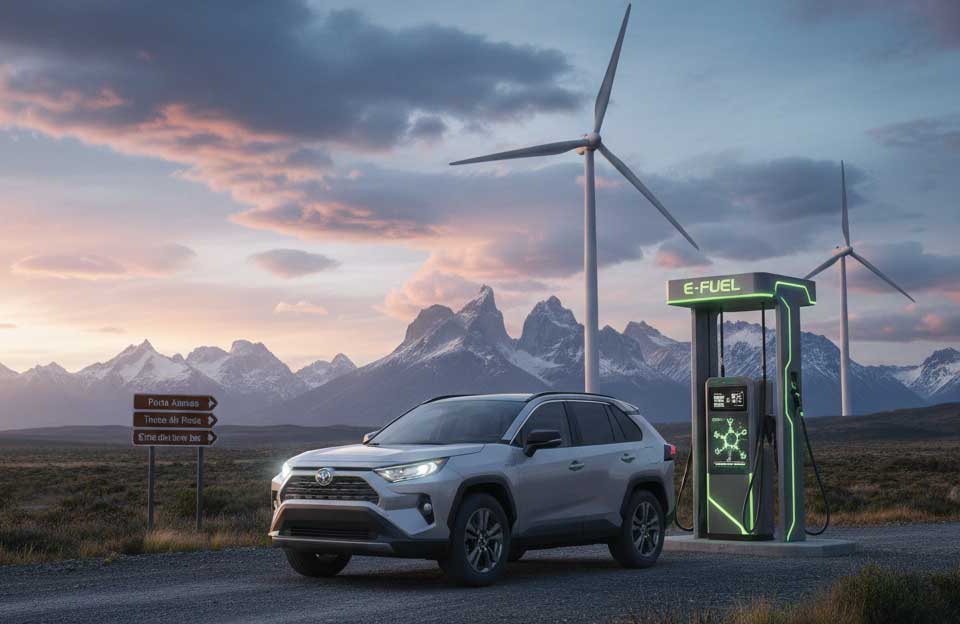
While much of the global conversation around decarbonization focuses on battery electric vehicles (BEVs), a fascinating alternative is taking shape in one of the world’s most extreme environments. In Punta Arenas, Chile, a new partnership between HIF Global, Toyota, and MITTA has launched “Route Zero”—a pilot project that combines hybrid technology with synthetic e-fuels.
This initiative is a practical response to a significant engineering challenge: how do we decarbonize transportation in remote regions where charging infrastructure is non-existent and distances are vast?
The Technology: e-Gasoline Meets Hybrid Efficiency
The “Route Zero” project utilizes a fleet of Toyota hybrid vehicles rented through MITTA. These vehicles are powered by e-Gasoline produced at HIF Global’s Haru Oni facility.
For those of us tracking chemical engineering breakthroughs, e-fuels are particularly exciting because they are chemically identical to conventional fossil fuels. They are created by capturing CO2 from the atmosphere and combining it with green hydrogen produced using wind energy.
- Drop-in Compatibility: Because the fuel is a “near-clone” of gasoline, it requires zero modifications to existing internal combustion engines or hybrid powertrains.
- The Hybrid Advantage: Toyota’s self-charging hybrids already reduce CO2 emissions by up to 40% compared to standard ICE vehicles. By swapping fossil fuel for carbon-neutral e-fuel, the net environmental impact drops toward near-zero without changing driver habits.
Why Patagonia?
Patagonia serves as a rigorous testing lab. With extreme winds, low temperatures, and thousands of miles of rugged terrain, it is an environment where current battery technology often struggles with range degradation and charging availability.
The “Route Zero” pilot will cover over 18,000 miles (30,000 kilometers) this summer. Tourists renting these hybrids in Punta Arenas will be able to refuel with 2,500 liters of free e-fuel provided by the program, effectively participating in a live demonstration of sustainable tourism.
The Bigger Picture: Decarbonizing the Existing Fleet
From an industry intelligence perspective, the HIF-Toyota alliance highlights a critical reality: even if every new car sold tomorrow were electric, there are still over 1.4 billion internal combustion vehicles on the road today.
E-fuels represent a “legacy-friendly” solution. As Víctor Turpaud, CEO of HIF Latam, noted, this technology allows for deep decarbonization by utilizing existing infrastructure—gas stations, tankers, and engines—while we continue to build out the electric grid.