At the core of every electric vehicle lies its battery—a sophisticated energy storage system that determines everything from range and performance to charging speed and cost. But how exactly do these power packs work? In essence, EV batteries store chemical energy and convert it into electrical energy to power the vehicle’s motor. This process relies on electrochemical reactions where ions (charged atoms) move between a positive electrode (cathode) and a negative electrode (anode) through an electrolyte. When charging, this process reverses, pushing the ions back to store energy.
However, not all EV batteries are created equal. Different chemical compositions lead to distinct types, each with its own set of advantages and disadvantages that car manufacturers weigh carefully. Let’s explore the leading battery types shaping the EV landscape today.
1. Lithium-ion (Li-ion) Batteries: The Industry Standard
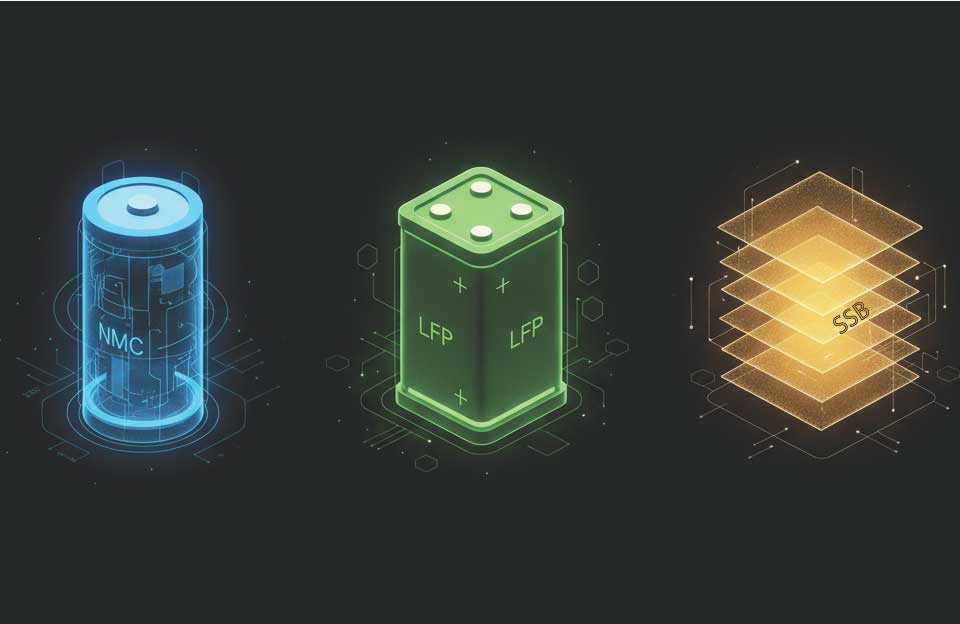
The vast majority of modern EVs rely on variations of lithium-ion technology. Within this category, two sub-types currently dominate the market: NMC and LFP.
a) Nickel Manganese Cobalt (NMC)
NMC batteries are renowned for their high energy density, meaning they can store a significant amount of energy in a relatively small and light package.
- Advantages: High energy density (long-range), strong power output for acceleration, and a proven track record in performance vehicles.
- Disadvantages: Higher cost due to raw materials like cobalt, and higher sensitivity to thermal stress, requiring advanced cooling systems.
b) Lithium Iron Phosphate (LFP)
LFP batteries have seen a massive surge in popularity, especially for standard-range and entry-level EVs.
- Advantages: Exceptional safety and thermal stability, lower manufacturing costs, and a longer overall lifespan (cycle life). They can also be charged to 100% daily with less degradation than NMC.
- Disadvantages: Lower energy density (heavier for the same range) and slightly reduced performance in extremely cold climates.
2. Solid-State Batteries (SSB): The Future Frontier
Solid-state batteries replace the liquid electrolyte found in traditional Li-ion batteries with a solid material. This change is widely considered the “holy grail” of EV technology.
- Advantages: Extremely high energy density (potentially doubling current ranges), non-flammable for superior safety, and the capability for ultra-fast charging.
- Disadvantages: Currently face high manufacturing costs and technical hurdles regarding large-scale durability. Mass-market adoption is expected toward the end of the decade.
Conclusion: A Diverse and Evolving Landscape
The choice of battery type significantly impacts an EV’s personality. NMC remains the go-to for luxury and performance, while LFP is the workhorse for affordability. As solid-state technology matures, the boundaries of what an electric vehicle can do will be pushed even further.