
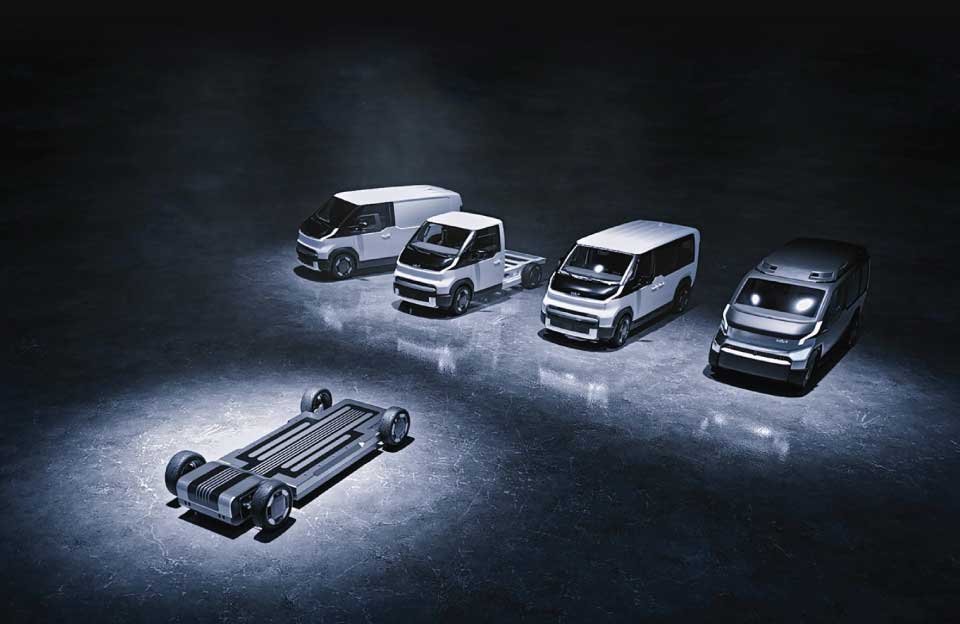
In the fast-evolving landscape of 2026, few vehicles have generated as much technical intrigue as the Kia PV5. Recently crowned the 2026 International Van of the Year (IVOTY), the PV5 is more than just a new entry into the electric light commercial vehicle (e-LCV) market. It serves as the cornerstone for Kia’s ambitious Platform Beyond Vehicle (PBV) strategy, marking a transition from traditional automotive manufacturing to a holistic mobility ecosystem.
Last week, Kia further expanded this ecosystem by announcing the “Open Bed” pickup version, adding yet another layer to a series that seems to redefine itself every few months.
Understanding PBV: The Architecture of Infinite Adaptability
To appreciate the PV5, one must first understand the philosophy of PBV (Platform Beyond Vehicle). While traditional automakers design a vehicle for a specific purpose—be it a sedan, an SUV, or a van—Kia’s PBV strategy flips the script. It treats the vehicle as a modular hardware platform that can be physically and digitally reconfigured to meet changing business or personal needs over its entire lifecycle.
At its core, PBV is defined by the “Easy Swap” technology and a standardized chassis, allowing a single vehicle to transition between being a daytime delivery van, a nighttime ride-hailing shuttle, and a weekend personal recreational vehicle.

The PBV (Platform Beyond Vehicle) ecosystem redefines automotive utility through a “blank sheet” engineering approach that prioritizes modularity and human-centric design. By utilizing a standardized “skateboard” chassis and a unique hybrid coupling system, the vehicle’s upper “Life Module” can be swapped to suit different business needs—transitioning from a cargo van to a passenger shuttle without requiring an entirely new fleet. Structural innovation, like ultra-low flat floor enhance this physical flexibility.
How is it managed to provide an Ultra-Low Floor?
In the realm of automotive engineering, achieving a floor that is both ultra-low and flat is a significant structural challenge. For the Kia PV5 and the broader PBV (Platform Beyond Vehicle) lineup, this is made possible through a synergy of bespoke EV architecture and advanced materials science.
The Ultra-Low Floor: E-GMP.S “Skateboard” Engineering
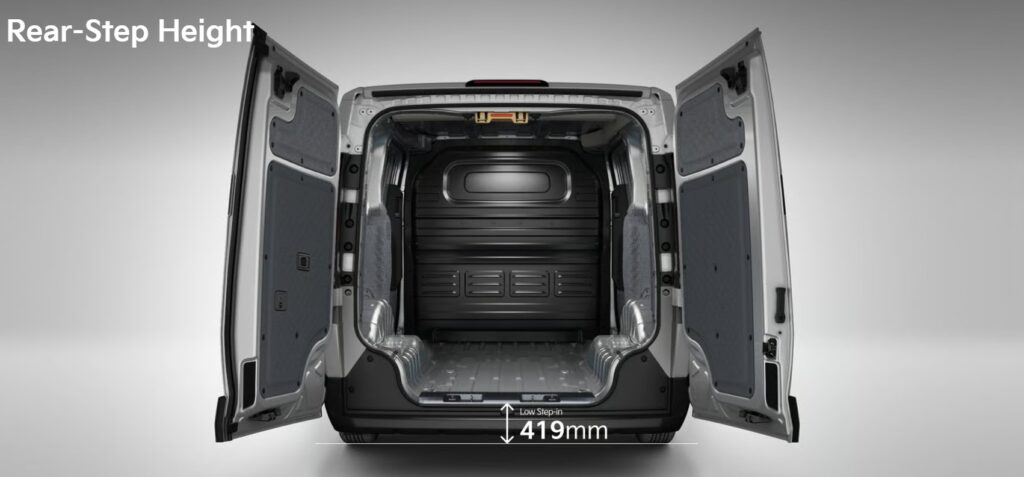
Achieving this floor level is only possible by allowing major architectural designs to converge into a single, cohesive unit. This synergy defines a new kind of urban-centric design; when compared to market competitors like the VW ID. Buzz or Ford E-Transit, the PV5 doesn’t just lower the load—it fundamentally lowers the barrier between the vehicle’s interior and the street, creating a workspace that is more accessible and ergonomic than any legacy adaptation could permit.
| Model | Ext. Dimensions (L / W / H) | Wheelbase | Lift-in Height (Sill) |
| Kia PV5 | 4,695 / 1,895 / 1,923 mm | 2,995 mm | 419 mm |
| VW ID. Buzz Cargo | 4,712 / 1,985 / 1,932 mm | 2,989 mm | 623 mm |
| Ford E-Transit Custom | 5,050 / 1,999 / 1,984 mm | 3,100 mm | 571 mm |
| Vauxhall Vivaro Electric | 4,983 / 1,920 / 1,890 mm | 3,275 mm | 542 mm |
| Maxus eDeliver 7 (L1H1) | 4,998 / 2,030 / 1,990 mm | 3,000 mm | ~550 mm |
Reduced Ground Clearance vs. Low Floor: The E-GMP.S platform is engineered with a loading height of just 419mm. This is achieved by mounting the suspension points higher up on the chassis frame, allowing the main floor pan to sit lower to the asphalt without sacrificing the protective clearance needed for the battery pack.
Flat Battery Packaging: The battery pack is designed as a “slim-profile” tray. By utilizing Cell-to-Pack (CTP) or even early-stage Cell-to-Chassis (CTC) technology, the battery cells are integrated directly into the floor structure. This serves a dual purpose: it lowers the center of gravity and reduces the total stack height of the vehicle floor.
Integrated Drive Units: Instead of a bulky engine and transmission, Kia uses a highly compact “All-in-One” power electric system. The motor, inverter, and reducer are integrated into a single housing that sits extremely low between the wheels.
Cargo Area: Built for Maximum Efficiency
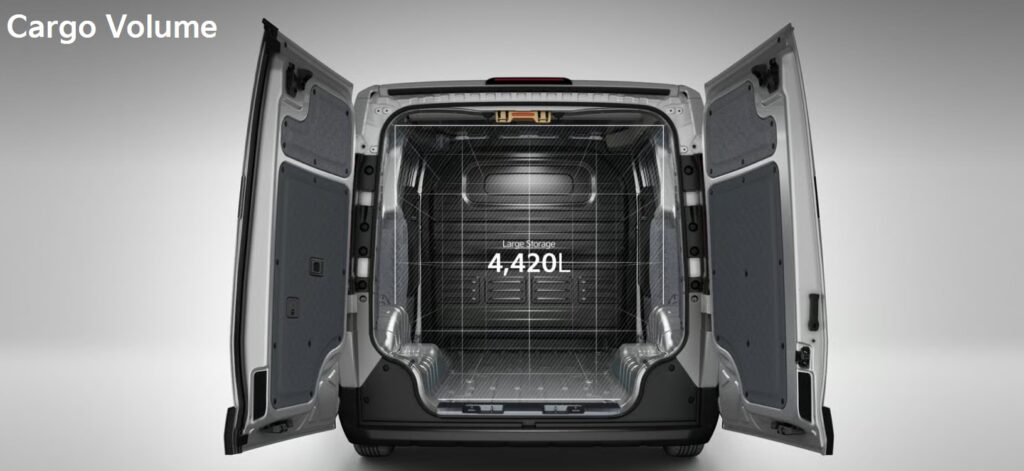
The cargo area of the PV5 is where Kia’s “blank sheet” engineering delivers its most tangible ROI for fleet operators. By adopting a cab-forward design, the engineers have effectively pushed the cockpit over the front axle, dedicating nearly two-thirds of the vehicle’s total length to the cargo zone. In the PV5 Long (L2H1) variant, this results in a remarkable load length of 2,255mm, allowing it to punch far above its weight class in the sub-5-meter segment.
The internal architecture is defined by near-vertical side walls and squared-off wheel arches. Unlike traditional vans where curved bodies create “dead space,” the PV5’s boxy geometry ensures that every millimeter of its 4.4 m³ volume is functional. This structural choice is critical for professional racking systems; the flat surfaces allow for seamless installation of modular shelving without the need for complex, custom brackets. Furthermore, the E-GMP.S platform’s ultra-low floor results in a 419mm loading threshold, which effectively turns the rear of the van into a walk-in workspace, significantly reducing the time and physical effort required for high-frequency “Last Mile” deliveries.
The PV5 is specifically engineered to handle two standard Euro Pallets (1,200 x 800 mm) with ease. While competitors often struggle to fit a second pallet due to protruding suspension towers or rear-motor humps, the PV5’s front-drive layout leaves the rear floor entirely flat and wide enough to accommodate standardized logistics units.
| Specification | Kia PV5 (L2/H1) | VW ID. Buzz Cargo | Ford E-Transit Custom (L1) | Vauxhall Vivaro Electric (S) |
| Exterior Length | 4,695 mm | 4,712 mm | 5,050 mm | 4,606 mm |
| Cargo Volume | 4.4 m³ | 3.9 m³ | 5.8 m³ | 4.6 m³ |
| Load Floor Length | 2,255 mm | 2,208 mm | 2,602 mm | 2,162 mm |
| Step-in Height | 419 mm | 623 mm | 571 mm | 544 mm |
| Max Payload | 790 kg | 650 kg | 1,011 kg | 1,000 kg |
| Euro Pallet Capacity | 2 Pallets | 2 Pallets | 3 Pallets | 2 Pallets |
Occupant Accommodation and Usage
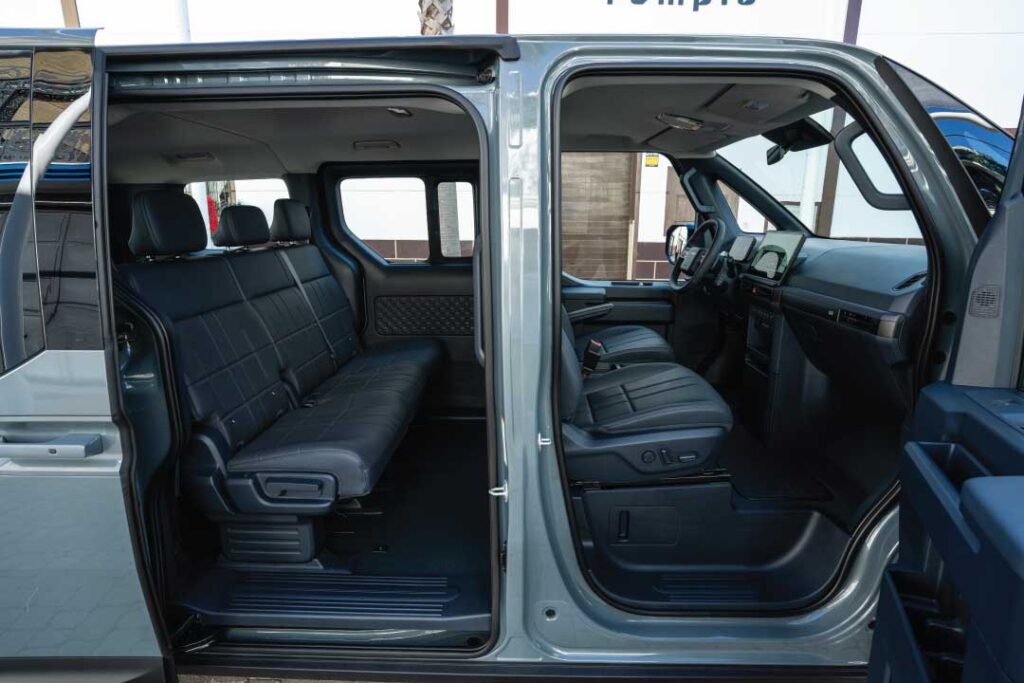
The interior of the PV5 is designed as a “Life Station,” bridging the gap between a high-efficiency delivery vehicle and a comfortable mobile office. By utilizing the E-GMP.S platform’s flat floor and minimal front overhang, Kia has created a cabin with class-leading legroom and a verticality that allows for seamless movement between the driver and passenger zones.
The PV5 is available in 5, 6, or 7-seat variations. The standout feature is the “Fold-and-Dive” second-row seating. These seats do not just fold; they sink into the floor to create a perfectly flat loading surface. In the 5-seater Passenger model, this expands the cargo capacity from 1,330 liters to a cavernous 3,615 liters, allowing for a rapid transition from passenger shuttle to bulk hauler.
The Mobile Office Concept: Designed for “downtime productivity,” the driver’s zone centers around a 7.5-inch digital cluster and a 12.9-inch infotainment screen running on an Android Automotive-based OS. To support professional needs, the cockpit includes:
- 100W USB-C Charging: Located in the dashboard tray, providing enough power to charge high-performance laptops without an adapter.
- Desk Functionality: A central sliding tray serves as a workstation, while the steering wheel is designed to fold away in specific trim levels to provide a flat desk surface when the vehicle is stationary.
- Inclusive Mobility (WAV): The PV5 WAV (Wheelchair Accessible Vehicle) is factory-produced, not a third-party conversion. It utilizes the 399mm side step-in height and a 300kg-rated side-entry ramp. Uniquely, the wheelchair user sits in the second row—not the rear—providing forward visibility and allowing for a third-row “tip-up” seat where a companion can sit directly alongside them.
Systems & Functions
Intelligent Software: The Android-Based SDx Strategy
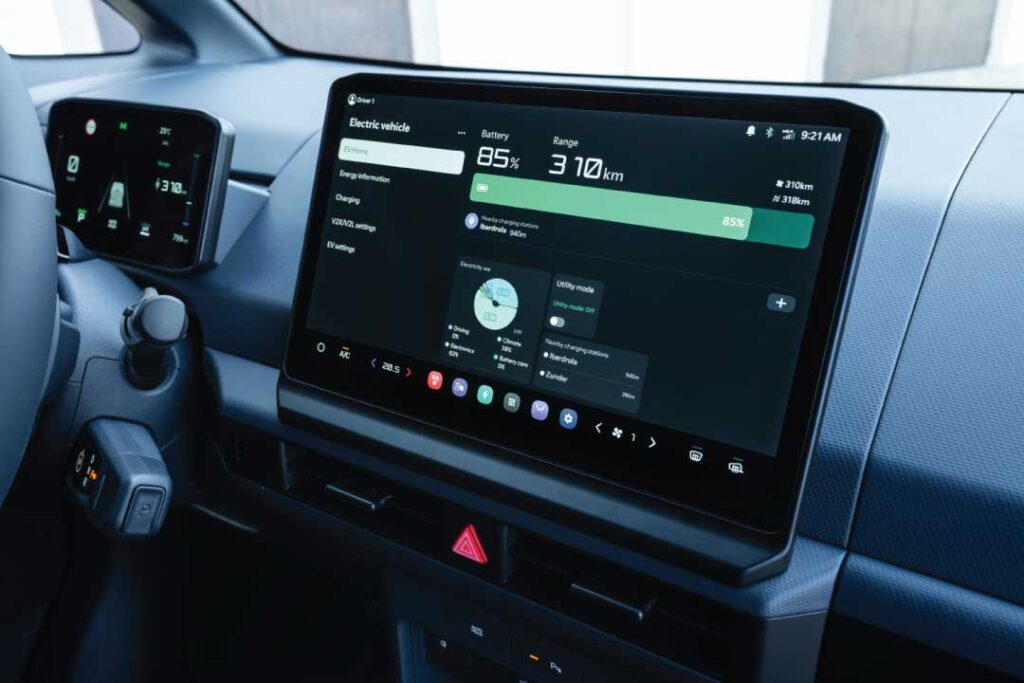
The PV5 is a Software-Defined Vehicle (SDV), meaning its functions are primarily managed and updated via the cloud.
Android Automotive OS (AAOS): Unlike standard car infotainment, the PV5 runs a PBV-specific AAOS. It features a “Hidden-until-lit” dashboard and a 12.9-inch display with an Open API (Application Programming Interface). This allows fleet operators to bake their proprietary delivery or logistics apps directly into the vehicle’s dashboard, eliminating the need for external tablets or phones.
Fleet Management System (FMS) via Geotab: In partnership with Geotab and 42dot, the PV5 features a hardware-free FMS. It provides real-time data on:
- Predictive Maintenance: Alerts for tire pressure or battery health before a breakdown occurs.
- Driver Behavior: Real-time monitoring of harsh braking or speeding to optimize safety and insurance costs.
- Digital Key 2.0: Uses Ultra-Wideband (UWB) technology to allow multiple drivers to access the vehicle via smartphone without physical keys—essential for shared fleets.
Energy & Power: Bi-Directional Utility
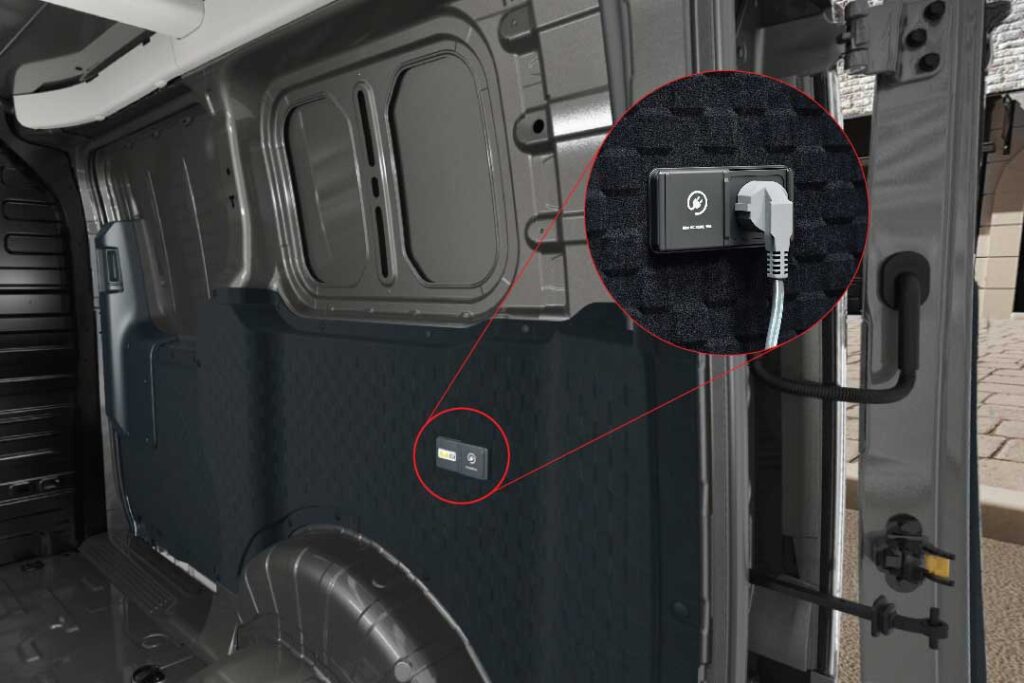
The PV5 acts as a mobile power bank, utilizing its 71.2 kWh NCM battery for more than just propulsion.
- V2L (Vehicle-to-Load): Provides up to 3.3kW to 3.6kW of AC power through internal and external sockets. This can run heavy-duty power tools, cooling units for catering, or mobile office equipment.
- V2G & V2H (Future Ready): The system is engineered for Vehicle-to-Grid and Vehicle-to-Home capabilities. This allows the vehicle to feed electricity back into a building or the local grid during peak hours, potentially generating revenue for the fleet owner while parked.
- Smart Regenerative Braking (i-Pedal 3.0): The system automatically adjusts the level of braking based on traffic flow and navigation data. This “one-pedal” logic is optimized for urban stop-and-go traffic to maximize range and minimize driver fatigue.
Euro NCAP Score of PV5 – Cargo & Passenger

In December 2025, Euro NCAP issued two different ratings for the PV5 based on separate testing protocols, despite both sharing the same Dual-Annular Exoskeleton structure.
Kia PV5 Cargo (5 Stars): Ranked as a top-tier commercial van. It excelled in Active Safety (ADAS), scoring 80% for its collision avoidance systems. Front occupant protection was rated “Good,” and it received high praise for its post-crash rescue features.
Kia PV5 Passenger (4 Stars): Tested under the more rigorous Passenger Car Protocol. While structurally sound, it lost the fifth star due to stricter rear-seat safety requirements, “Weak” chest protection for rear passengers in specific impacts, and “Poor” pedestrian pelvis protection caused by its boxy front design.